We recently discussed win ratios on our podcast CRITKNOW (https://youtu.be/gQpXct08AmU?si=sygwFWd2jIj2w3j-) in the context of the Andromeda-Shock-2 trial. In this blog, we take a deeper dive into the concept and how it is applied in clinical trials.
Similar to risk ratios and odds ratios, the win ratio is a measure of treatment effect. However, it is particularly useful when analysing hierarchical composite outcomes, where individual components are prioritised based on clinical importance—as in the Andromeda-Shock-2 trial.
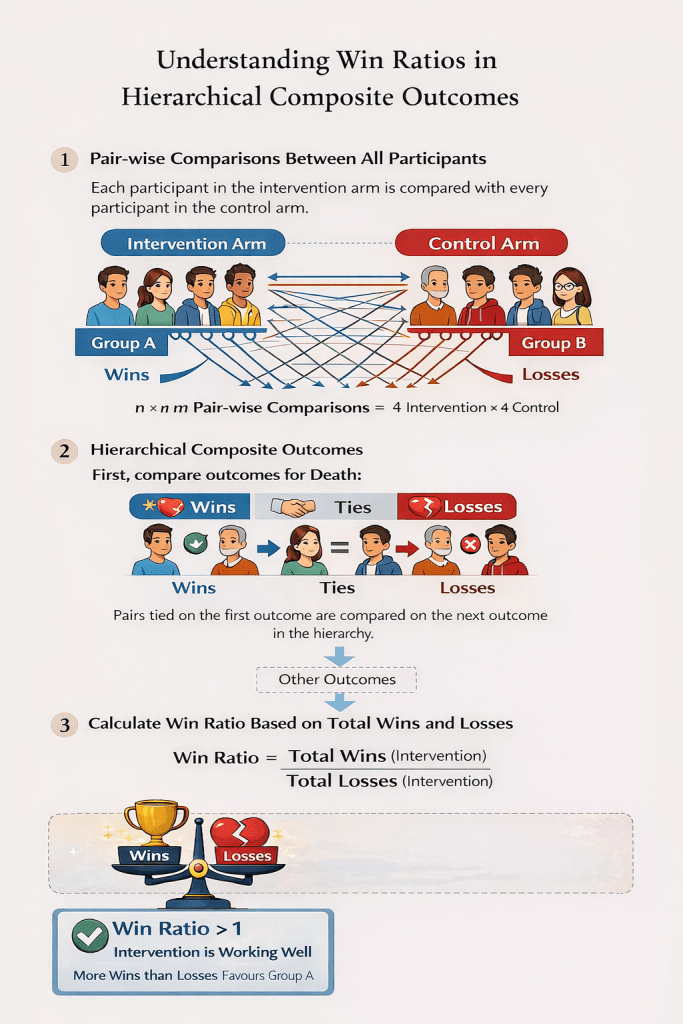
Steps involved in estimating the win ratio (see figure)
1. Generate all pairwise comparisons
Each participant in the intervention arm is compared with every participant in the control arm, generating all possible pairs.
For example, 100 participants in each arm result in 10,000 pairwise comparisons (100 × 100).
2. Compare outcomes hierarchically
Each pair is evaluated across outcomes in a predefined hierarchy. In Andromeda-Shock-2, this includes:
- Death
- Organ support
- Length of hospital stay
The comparison always starts with the most important outcome.
3. Classify each comparison as a win, loss, or tie
For each outcome:
- If the intervention patient has a better outcome, this is a win for the intervention arm.
- If the control patient has a better outcome, this is a loss for the intervention arm.
- If both patients have the same outcome, this is a tie.
For example, for mortality:
- Intervention survives and control dies → win
- Intervention dies and control survives → loss
- Both survive or both die → tie
In the Andromeda-Shock-2 framework, if both patients in a pair die, this represents an early tie, and the pair does not proceed further in the hierarchy.
4. Progress tied pairs to the next outcome
If a pair is tied on a higher-priority outcome (e.g., both survive), the comparison moves to the next outcome:
- For organ support–free days, the participant with more days is considered the winner.
- If still tied, the comparison moves further down the hierarchy.
Finally, for length of hospital stay, a shorter duration is considered a win.
5. Aggregate wins and losses
After all pairwise comparisons are completed:
- Total wins and losses for the intervention arm are counted
- Ties are excluded from the calculation
Calculating the win ratio
Win Ratio = Total wins (intervention) ÷ Total losses (intervention)
Interpretation
- Win Ratio > 1: The intervention is superior to the control arm (more wins than losses)
- Win Ratio < 1: The intervention is inferior to the control arm (more losses than wins)
- Win Ratio = 1: No difference demonstrated between the groups
As with any effect estimate, interpretation should consider the 95% confidence interval and overall clinical context.
Limitations:
- The approach ignores ties and if a large proportion of participants are tied, the win ratio may potentially overestimate treatment effects. The use of win difference has been proposed as a measure to mitigate this.
- A win ratio > 1 may be driven by a higher number of wins on a relatively less important outcome. We see this in Andromeda-Shock- 2 where the wins appear to be driven by marginal improvements in the duration of organ support.
In summary, the win ratio provides a clinically intuitive way to analyse composite outcomes by respecting the relative importance of each component while making full use of all pairwise comparisons.
Suggested reading:
- https://evidence.nejm.org/doi/full/10.1056/EVIDstat2500187
- https://academic.oup.com/eurheartj/article/45/44/4684/7822474
- https://pmc.ncbi.nlm.nih.gov/articles/PMC10322884/
 ccmevidence
Leave a comment